Tenant guide
What Is an HMO Property in the UK? A Plain-English Guide for Renters and Landlords in Kent
Last updated: 2 November 2026. This guide is general information, not legal or planning advice. It covers HMO rules in England, with local notes for Medway. Always check the latest position with your council.
If you’ve looked at rooms to rent in Gillingham, Chatham or Gravesend, you’ve probably seen the letters “HMO”. Here’s what an HMO is, when it needs a licence, what’s changing in Medway, and what living in one is actually like.
What is an HMO?
HMO stands for “house in multiple occupation”. GOV.UK describes it as a property rented out by at least 3 people who are not from 1 household (for example, a family) but who share facilities like the bathroom and kitchen. It’s often just called a house share.
So a property is usually an HMO if:
- 3 or more people live there,
- they form 2 or more households, and
- they share a kitchen, bathroom or toilet.
The law also expects it to be the tenants’ only or main home, with at least one of them paying rent.
What counts as a “household”?
A household is a single person, or members of the same family living together. Under the Housing Act 2004 that includes couples (married, civil partners or living together) and relatives such as parents, children, grandparents, brothers and sisters, aunts, uncles, nieces, nephews and cousins.
| Who lives there | People | Households | HMO? |
|---|---|---|---|
| Three friends sharing a house and kitchen | 3 | 3 | Yes |
| A couple plus one friend, sharing the kitchen | 3 | 2 | Yes |
| Five unrelated sharers, each with their own room | 5 | 5 | Yes, and a large HMO that needs a mandatory licence |
| A family of five | 5 | 1 | No |
| Two unrelated friends sharing a flat | 2 | 2 | No (but see selective licensing below) |
Do HMOs need a licence?
Some do, and it depends on the size of the HMO and where it is.
Mandatory licensing: large HMOs (5 or more people)
You must have a licence anywhere in England if your property is rented to 5 or more people who form more than 1 household, and some or all of them share a toilet, bathroom or kitchen.
- A licence lasts for up to 5 years, and you need a separate licence for each HMO.
- The council checks the house is suitable for the number of people, and that the manager is a “fit and proper” person.
- Licence holders must send the council an updated gas safety certificate every year, install and maintain smoke alarms, and provide electrical safety certificates when asked.
- Renting out an unlicensed HMO can lead to an unlimited fine. Tenants can also apply for a rent repayment order of up to 2 years’ rent.
Minimum bedroom sizes: licensed HMOs in England must meet legal minimum room sizes. A bedroom for one person over 10 must be at least 6.51 square metres, and one for two people over 10 at least 10.22 square metres. A room smaller than 4.64 square metres can’t be used as a bedroom at all.
Medway: additional HMO licensing from 4 January 2027
From Monday 4 January 2027, Medway Council’s additional HMO licensing scheme covers smaller HMOs. You’ll need a licence if your property is rented to 3 or 4 people from more than one household, with shared facilities, in one of these six wards:
- Chatham Central and Brompton
- Fort Pitt
- Gillingham North
- Gillingham South
- Luton
- Watling
Medway Council says you can’t apply before 4 January 2027, and most licences will last until 3 January 2032, when the scheme is due to end.
Medway: selective licensing (not HMOs)
Medway’s selective licensing scheme also starts on 4 January 2027. It covers homes let to a single household or 2 unrelated people sharing in seven wards: the six above plus Strood North and Frindsbury. So even lets that aren’t HMOs may need a licence.
Article 4: planning permission in seven Medway wards
Licensing and planning are separate. In planning terms, a small HMO (Class C4) is a home lived in by no more than six residents as an HMO. Normally a family home (Class C3) can become a small HMO without planning permission.
In seven Medway wards, an Article 4 Direction removes that right. Since 22 January 2026, you need planning permission to turn a family home into a small HMO in Chatham Central and Brompton, Fort Pitt, Gillingham North, Gillingham South, Luton, Strood North and Frindsbury, and Watling. Medway Council’s Cabinet confirmed the directions on 5 May 2026.
For ward maps, fees and a checklist, read our Medway Article 4 and HMO licensing 2027 guide.
What’s it like living in an HMO?
For many people, an HMO is simply a house share: you have your own bedroom (sometimes with an en-suite) and share the kitchen, bathrooms and living areas with your housemates.
What’s usually included
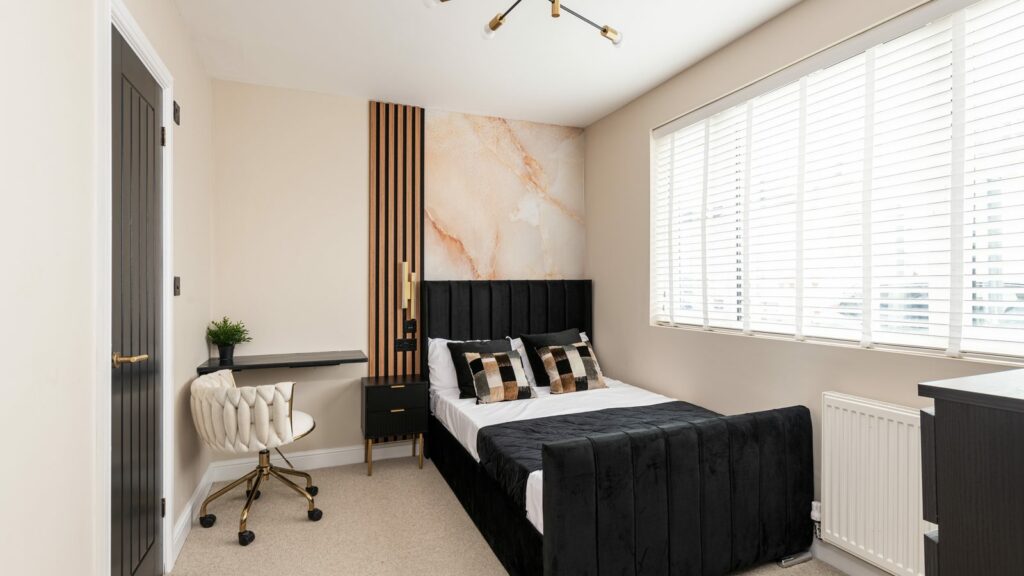
- A furnished room. Many HMO rooms come with a bed, storage and often a desk.
- Shared spaces. A kitchen, bathroom or bathrooms, and sometimes a lounge or garden.
- Bills. Many HMO rooms are let with bills included. All of A & E Property’s own HMO rooms are bills included, so you pay one monthly amount. What’s covered can vary by house, so check the listing. Our guide to what’s included in an all-bills-included room explains what to ask.
Extra safety rules
HMOs have their own management rules in England. The person managing the house must:
- give every household their name, address and phone number, and display them somewhere obvious in the house,
- keep fire escapes clear and fire safety measures in good order,
- keep the water, drainage, gas and electricity supplies working,
- keep shared areas, fixtures and appliances in good repair, as well as each tenant’s room, and
- provide suitable bins and rubbish storage.
Tenants have duties too, such as taking reasonable care not to damage the property, following the arrangements for rubbish, and following the manager’s reasonable instructions on fire safety.
Your rights as a tenant
If your landlord doesn’t live in the house, you’re likely to have an assured periodic tenancy under the Renters’ Rights Act. That means a rolling tenancy with no fixed end date, at least 2 months’ notice if you want to leave, and no “no fault” evictions. Read our guide: Does the Renters’ Rights Act apply to HMOs?
The good and the not-so-good
- Good: can be a more affordable and simpler way to rent than taking on a whole flat alone, rooms are often ready to move into, bills often sorted, and built-in company.
- Less good: you share the kitchen and bathroom, so house rules and considerate housemates matter. Ask about cleaning, guests, quiet hours and how repairs are reported before you move in.
Questions to ask before you rent an HMO room
- If the house needs a licence, does it have one?
- What exactly do the bills cover?
- How many people share the kitchen and each bathroom?
- Who manages the house, and how do you report repairs?
- Is there a deposit, and which government-approved scheme protects it?
HMO rooms to rent in Medway and North Kent
A & E Property lets professional house shares across Medway and North Kent. Browse current rooms by area:
- Rooms to rent in Medway
- Rooms to rent in Gillingham
- Rooms to rent in Chatham
- Rooms to rent in Rochester
- Rooms to rent in Strood
- Rooms to rent in Gravesend
- Rooms to rent in Northfleet
Thinking of letting an HMO?
Running an HMO means keeping on top of licensing, safety certificates, tenancies and repairs. A & E Property runs its own HMOs and offers a full management service to other landlords in Medway and North Kent, covering tenant find, rent collection and maintenance.
See our HMO management service · View our landlord fees · 01634 907 011 · info@ae-propertyltd.co.uk
FAQs
What does HMO stand for?
HMO stands for house in multiple occupation. It’s a home rented out to at least 3 people from more than one household who share facilities such as a kitchen or bathroom. It’s often called a house share.
How many people make a house an HMO?
At least 3 people who form 2 or more households and share facilities. A house with 5 or more people from more than one household is a large HMO and needs a mandatory licence anywhere in England.
Is a couple and a friend sharing a house an HMO?
Yes, usually. That’s 3 people forming 2 households (the couple counts as one), so if they share the kitchen or bathroom, the house is an HMO.
Is a house share the same as an HMO?
Usually, yes. Most house shares with 3 or more unrelated people sharing a kitchen or bathroom are HMOs. Two unrelated people sharing a flat is not an HMO.
Does every HMO need a licence?
No. Large HMOs with 5 or more people from more than one household need a licence anywhere in England. Smaller HMOs only need one where the council runs an additional licensing scheme. In Medway, that applies to 3 or 4 person HMOs in six wards from 4 January 2027.
Do I need planning permission to turn a house into an HMO in Medway?
In seven Medway wards, yes. Since 22 January 2026, an Article 4 Direction means changing a family home into a small HMO (up to six residents) needs planning permission there. Larger HMOs are a separate planning category and are already assessed through the planning system.
Are bills included in an HMO room?
It depends on the landlord and the house. All of A & E Property’s own HMO rooms are let with bills included, but what’s covered can vary by house, so always check the listing.
Are HMOs safe to live in?
HMOs have extra legal safety rules. The manager must keep fire safety measures in good order, maintain the gas, electricity and water supplies, keep shared areas in good repair and display their contact details. Licensed HMOs must also meet minimum bedroom sizes.
Can I rent an HMO room if I get Universal Credit?
Yes. Since 1 May 2026, it’s illegal for landlords and agents to refuse you or put you off because you get benefits. They can still check you can afford the rent, but they must count benefit income like any other income.
Sources
- GOV.UK, House in multiple occupation licence: https://www.gov.uk/house-in-multiple-occupation-licence
- Medway Council, About houses in multiple occupation (HMOs): https://www.medway.gov.uk/info/200924/houses_in_multiple_occupation_hmos/739/houses_in_multiple_occupation_hmos
- Medway Council, Private rented sector licensing: https://www.medway.gov.uk/info/200134/housing/2091/private_rented_sector_licensing
- Medway Council, Article 4 Directions: https://www.medway.gov.uk/info/200147/applying_for_planning_permission/553/article_4_directions
- legislation.gov.uk, Housing Act 2004, section 254 (meaning of “house in multiple occupation”): https://www.legislation.gov.uk/ukpga/2004/34/section/254
- legislation.gov.uk, Housing Act 2004, section 258 (persons not forming a single household): https://www.legislation.gov.uk/ukpga/2004/34/section/258
- legislation.gov.uk, The Licensing of Houses in Multiple Occupation (Prescribed Description) (England) Order 2018, article 4: https://www.legislation.gov.uk/uksi/2018/221/article/4/made
- legislation.gov.uk, The Licensing of Houses in Multiple Occupation (Mandatory Conditions of Licences) (England) Regulations 2018: https://www.legislation.gov.uk/uksi/2018/616/regulation/2
- legislation.gov.uk, The Management of Houses in Multiple Occupation (England) Regulations 2006: https://www.legislation.gov.uk/uksi/2006/372/contents/made
- legislation.gov.uk, The Town and Country Planning (Use Classes) Order 1987, Schedule (Class C4): https://www.legislation.gov.uk/uksi/1987/764/schedule
- GOV.UK, Renters’ Rights Act overview for tenants: https://www.gov.uk/guidance/renters-rights-act-overview-for-tenants
- GOV.UK, Rental discrimination: a guide for landlords: https://www.gov.uk/rental-discrimination-landlords
